Canny is the B2B alternative to Chattermill
Chattermill is a customer experience platform built for large consumer brands. It analyzes feedback at enterprise scale, and it’s priced for big CX teams.
Canny is built for B2B SaaS product teams. It collects and captures feedback, organizes it by product area, and analyzes it with a revenue focus. And it closes the loop with your customers, inside and out. It starts free and is live in hours.
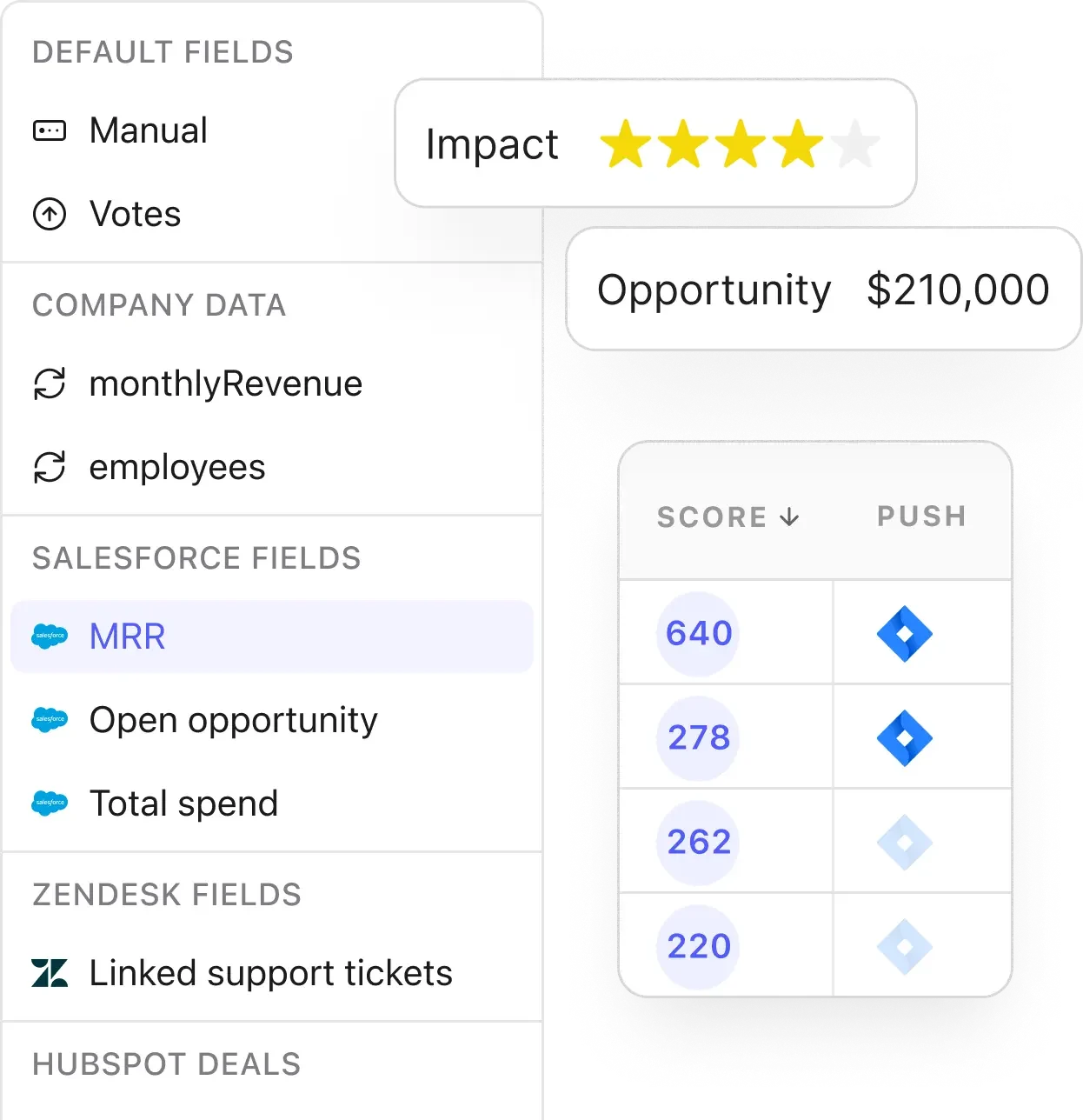
Table of contents
Quick look: Why people prefer Canny over Chattermill

Capture and collect feedback in one place
Like Canny, Chattermill captures feedback automatically from the tools you connect, including surveys, reviews, social, and support tickets. The gap is on the other side. It has no place for your customers to submit feedback directly. Everything it analyzes has to originate somewhere else first.
Canny captures from both directions. Autopilot pulls requests and problems from your team’s conversations in Gong, Intercom, Slack, and Zendesk. Portal, a public space for your customers, lets them submit feedback and vote directly. Both flow into Ideas, the home in Canny where every request is organized, prioritized, and connected to revenue. You capture from your conversations and collect straight from your customers, in one place.
Organize feedback around how your team works
In Ideas, you define the product areas and teams you care about. Feedback sorts into them automatically, with duplicates merged. The structure matches how your product and team actually work. Every request lands with the person who owns it. You can see detailed views by each product area to dig into the specifics.
Chattermill organizes feedback too, but its AI builds the structure for you, tuned to standardize analysis at scale. The difference is control. Canny gives you a structure you shape around your team; Chattermill gives you a generated one built for studying feedback.
Get the insight without the analytics project
Chattermill is built for deep CX analysis at scale. Its AI, Lyra, scores sentiment and analyzes themes across surveys, reviews, social, and calls. Its dashboards and impact analysis are tuned for very high feedback volumes.
Canny gives you the analysis you need to decide what to build, without a separate analytics project to run it. You define the themes that matter, and Autopilot tags feedback to them, with a trends report over time. You can segment by customer and plan, and weigh requests by customer demand and ARR. The reporting is built around the decision: ARR at stake, dealbreakers, and renewal risk by account. Then you act on it in the same place.
The difference is purpose. Chattermill is built to study feedback. Canny is built to turn it into shipped features.
Connect feedback to revenue, and act on it
Both tools connect feedback to revenue. Chattermill connects Salesforce and CRM data, so feedback sits next to the account behind it. It ties themes to metrics like NPS and CSAT. The difference is what you do next.
In Canny, every request carries its revenue context. You see the ARR at stake and the open pipeline riding on each request. You also see the revenue lost when customers churned over features you never shipped.
Sort your roadmap by the dollars in play. The work that protects the most revenue rises to the top, right where you prioritize and ship. Build the feature that moves the number, then tell the account owner the day it ships. Revenue is a decision input here, not a report you read after the fact.
Bring your feedback into ChatGPT, Claude, and Cursor
Connect Canny to ChatGPT, Claude, or Cursor via MCP. This lets you work on your feedback without leaving your AI tools. Ask what your top accounts keep requesting. Pull every request tied to an at-risk renewal. Draft a roadmap update from your highest-revenue feedback.
And it goes both ways. Your LLM can read your feedback and write back to it. That means creating and updating requests, linking revenue, and managing views. Chattermill’s MCP can query your feedback, but it can’t write back to it. The read-and-write loop makes your AI tools a way to run Canny, not just ask it questions.
Close the loop, inside and out
Chattermill is an internal analytics layer. It gives your team a read on what customers feel, but it gives your customers nowhere to go, and it doesn’t help you follow up with them.
Canny closes the loop on both sides. Your customers get a roadmap that shows what you’re building. Changelog updates share your latest releases. So the people who asked hear about it automatically. Your team gets the internal side too. Account owners are notified when a feature their customer requested ships. And you can export the list of everyone who asked, and follow up directly. That’s how feedback turns into retention, because customers see that you listened.
Start free, skip the enterprise contract
Chattermill is quote-only, and third-party benchmarks put the average contract around $64,000 a year. There is no free plan or trial. It recommends a minimum of 5,000 pieces of feedback a month to be worth it. And every plan includes an implementation and onboarding project. Between the cost and the volume minimum, it’s out of reach for smaller teams.
Canny starts free, and paid plans begin at $79 a month. Pricing scales with how many customers give you feedback, so it grows with you. It stays a fraction of an enterprise analytics contract. Most teams are live in hours, not weeks.
How Mercury turns scattered requests into a roadmap
Mercury builds banking for startups. It used to track feature requests across Slack, email, Notion, and Linear, until it got messy. With Canny as one source of truth, the team runs weekly syncs to prioritize the roadmap. They close the loop by telling customers when their request ships.
“We actually saw an increase in user feedback because our users saw that we really do care about their feedback and invest in it.”
See Canny on your own feedback
Start free in minutes, or book a demo to see how Canny captures, prioritizes, and closes the loop on customer feedback.